2026-07-03 · By Reuben Lopez · Estimated 8 min read
Is Your Law Firm's Website an ADA Lawsuit Waiting to Happen?
An ADA-compliant law firm website meets WCAG 2.1 AA accessibility standards in its underlying code: proper alt text, keyboard navigation, labeled forms, and sufficient color contrast, not through an overlay widget. For Ohio law firms, that distinction matters: lawsuits rose 27% in 2025, and courts are not accepting widgets as a defense.
If you are a managing partner, practice administrator, or marketing director at an Ohio law firm evaluating website liability, this guide is for you. It is not a generic accessibility tutorial. It is a straight look at what actually protects your firm, and what does not.
There is a particular kind of embarrassing that comes with a law firm getting sued over its own website. You advise clients on liability for a living, and your own digital front door is sitting there as an open case.
It is not a hypothetical. It is a documented, growing trend, and it is not slowing down.
Are ADA Website Lawsuits Increasing for Law Firms?
Plaintiffs filed 3,117 website accessibility lawsuits in federal courts alone in 2025, making up roughly 36% of all ADA Title III federal lawsuits. An additional ~2,000 cases were filed in key state courts, particularly where state laws like California's Unruh Act allow for financial damages (Accessibility Checker, ADA Lawsuit Trends 2025/2026). Federal filings alone do not capture the full picture, and the filing pattern has been spreading as plaintiff firms expand their reach beyond traditional hot spots like New York and Florida.
Here is the part that should actually worry you: nearly 95% of websites tested still fail basic accessibility checks, according to the WebAIM Million report, one of the most widely cited accessibility studies in the industry. That is not a fringe problem. That is most websites, including a lot of law firm sites that look polished on the surface.
Law firms are not the top-targeted industry (e-commerce and restaurants get hit hardest), but “not the top target” is not the same as “safe.” And unlike a restaurant, a law firm getting hit with an ADA demand letter has a credibility problem that goes beyond the settlement check.
The numbers are moving in the wrong direction. Waiting for a demand letter before acting is not a strategy. It is a bet that your firm will be in the 5% that pass basic checks, or that plaintiff firms will not find you. Neither is a position a liability advisor should be comfortable holding.
Do Accessibility Widgets Make a Law Firm Website Compliant?
A lot of businesses respond to accessibility concerns by bolting on one of those accessibility overlay widgets: the little icon in the corner that promises instant compliance. Skip it.
Roughly 22% of website accessibility lawsuits in 2025 targeted sites that already had one of these widgets installed. The FTC fined a major overlay provider $1 million for misrepresenting what its widget could actually guarantee (FTC, January 2025). Courts are not treating “we bought a widget” as a defense, and plaintiffs' firms know exactly which overlay products do not hold up. Some complaints now specifically call out sites for using them.
Real accessibility work happens in the code: proper alt text, keyboard navigation, form labels, color contrast, readable structure for screen readers. That is the difference between a site that is actually usable and one that is just wearing a compliance badge.
How Can You Check Surface-Level Accessibility Issues?
Overlay widgets are not the answer, but that does not mean you have to guess where your site stands. WAVE (WebAIM's Web Accessibility Evaluation Tool) is a free scanner that catches surface-level issues: missing alt text, contrast problems, heading structure gaps, and form label errors. Enter your firm's URL and you get a quick read on obvious problems, a useful first pass before anything else.
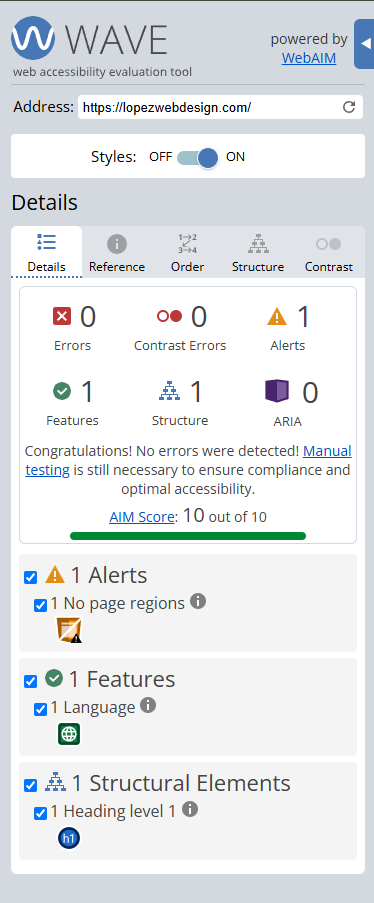
A clean WAVE report is not a compliance certificate. The tool itself notes that manual testing is still necessary, and that is the point. Automated scanners catch what machines can see; they miss keyboard navigation flows, screen reader usability, and intake form behavior that only human review reveals. Think of WAVE as a smoke detector, not a building inspection.
For official guidance on what businesses open to the public, including law firms under ADA Title III, actually need to consider, see the Department of Justice's Guidance on Web Accessibility and the ADA. It points to WCAG as helpful technical guidance and recommends pairing automated checkers with manual review, not relying on either one alone.
Why Isn't ADA Compliance a One-Time Project?
Here is what a lot of firms get wrong: they treat accessibility like a one-time fix. Get it “done,” move on.
It does not work that way. Every time you add a blog post, upload a new attorney bio photo, embed a new intake form, or swap out a page layout, you can introduce a new accessibility gap without knowing it. A site that was compliant at launch can drift out of compliance within months, not because anything broke, but because nobody was watching it.
Think of it the same way you would think of an oil change. You do not change your oil once and assume the engine is covered for life. Your website's accessibility and its underlying code health generally needs the same ongoing attention, or the risk quietly builds back up. That is digital plumbing: unglamorous, easy to ignore, and exactly the kind of thing that causes real damage when it is neglected.
For a deeper look at ongoing website care, see our guide on The Digital Oil Change. And because compliance is not a one-time event, ongoing monitoring is available afterward as an optional plan through our Ongoing Care, not a mandatory retainer you are locked into just to keep your site running.
What's the Difference Between ADA and WCAG?
These terms get used interchangeably, but they are not the same thing, and the distinction matters when you are evaluating what your firm actually needs.
ADA Title III is the federal civil rights law that prohibits discrimination against people with disabilities in places of public accommodation. Courts have consistently allowed accessibility lawsuits against private business websites to proceed under Title III, but there is no single federal regulation that spells out exact website technical requirements for private businesses like law firms.
WCAG (Web Content Accessibility Guidelines) is the technical standard most commonly referenced in lawsuits and settlements as evidence of what “accessible” looks like. WCAG 2.1 Level AA is the benchmark most courts and settlements point to, even without a law firm-specific regulation on the books.
When someone says they want an “ADA-compliant” website, what they usually mean in practice is a site built to WCAG 2.1 AA in its underlying code. That is the strongest documented defense available and shows a genuine good-faith effort, not a shortcut.
What Should an ADA-Compliant Law Firm Website Include?
The Blueprint for Law Firms is not a website with accessibility bolted on afterward. It is built in from the start:
- Multi-page professional site architecture
- ADA compliance audit as part of the build, not a separate line item you have to remember to ask for
- Secure intake forms
- Attorney bio and practice area pages
- AI SEO services built for how people actually search for a lawyer in your area
- Analytics & Search Console installation, extended search index setup
- 60 days of post-launch support
And because compliance is not a one-time event, ongoing monitoring is available afterward as an optional plan, not a mandatory retainer you are locked into just to keep your site running.
Frequently Asked Questions About ADA Law Firm Websites
How many websites are not ADA compliant?
The 2026 WebAIM Million report, the most widely cited study of its kind, found that 95.9% of home pages had at least one detectable WCAG failure, up from 94.8% the year before. That's the first year accessibility got measurably worse since WebAIM started tracking it. If your firm's site hasn't had a real code-level audit, the odds are it's failing somewhere, whether you can see it or not.
Can I be sued if my website is not ADA compliant?
Yes. Courts have consistently allowed ADA accessibility lawsuits against private business websites to proceed under Title III, and law firms aren't exempt just because they're a professional office rather than a retail storefront. Over 3,100 website accessibility lawsuits were filed in 2025 alone, a 27% jump from the year before, so this isn't a rare or theoretical risk anymore.
What websites are exempt from ADA compliance?
Very few. Title III carves out exemptions for religious organizations and true private membership clubs. That's it. There's no small-business exemption and no exemption for professional service firms. If your website is open to the public, including a law firm's, it's expected to be accessible.
How can I tell if a website is ADA compliant?
Start with a free scanner like WAVE. It flags surface-level issues like missing alt text, poor contrast, and heading problems in seconds. Or start with our ADA Website Risk Score for a self-assessment against common risk factors. But a clean scan isn't the same as full compliance. WAVE itself notes that manual testing is still necessary to catch things like keyboard navigation and screen reader usability, which automated tools can't see.
This page is provided for general informational purposes and reflects publicly available data on accessibility litigation trends. It is not legal advice, and Lopez Web Design is not a law firm. Website accessibility work can reduce risk and demonstrate good-faith effort, but it does not guarantee immunity from claims. For guidance on your firm's specific legal obligations, consult a licensed attorney.
More Field Manuals
More practical field reports for business owners navigating their digital terrain.
The Web Design Blueprint for Dayton Handymen and Contractors
A no-fluff blueprint for trades and contractors: mobile-first sites that turn "near me" searches into booked jobs, built for owners who live on calls and referrals.
Read the GuideCan ChatGPT Build Me a Website?
Yes, ChatGPT can write a website's code and copy. But it won't bring traffic, convert visitors, or match your vision without a real design process.
Read the GuideGoogle Business Profile Optimization Checklist (2026)
A free, step-by-step Google Business Profile checklist for local businesses. What to fill out, what to avoid, and how to rank higher on Google Maps.
Read the GuideI Audited 7 Dayton Contractor Websites. Here's What Broke.
Seven Dayton-area contractor sites, seven owners with good reviews, and the same handful of problems on nearly every one.
Read the GuideWhat Is a Fair Price for a Website? A 2026 Cost Breakdown for Dayton-Area Businesses
A fair price for a small business website is $2,500–$5,000 for most Dayton-area businesses. See real 2026 pricing by provider, site type, and monthly costs.
Read the GuideThe Hidden Costs of DIY Web Design: Is It Actually Cheaper?
The true cost of DIY website builders: domains, SEO, analytics, and why free tiers end up costing time and revenue.
Read the GuideBuilding a Local E-Commerce Engine: How Dayton Shops Can Start Selling Online
How Dayton shops can start selling online: the four pillars (storefront, inventory, shipping, payments), real costs, and a playbook that fits how you already run your store.
Read the GuideWhat a Custom E-Commerce Website Actually Costs in Dayton (No Games, No Surprises)
Real, flat-rate pricing for custom e-commerce websites in Dayton, Ohio. No hourly billing, no hidden fees, no retainer traps.
Read the GuideThe Digital Oil Change: Why Your Dayton Business Needs Regular Website Maintenance
Ongoing website maintenance as a local service. We handle security, backups, and performance for Dayton businesses so your site stays reliable while you run the job. Predictable care beats $3K+ emergencies.
Read the GuideThe Dayton Shop-Owner's Manual
Repair your Dayton online store: leaky checkouts, broken mobile shops, and affordable e-commerce fixes. Field guide for local retailers selling online in 2026.
Read the Guide